


If you’ve ever looked at a farmhouse or a few wooded acres in western Pender County, you’ve probably noticed that “public water” isn’t a given. Much of the county still runs on private wells, and this fall the Pender County Board of Commissioners has been working to change that for part of the northwest corner around Penderlea and the U.S. 421 corridor. Here’s what’s happening, where things stand as of late October 2026, and what it means if you own, sell, or plan to buy rural property in the area.
What the County Is Pursuing
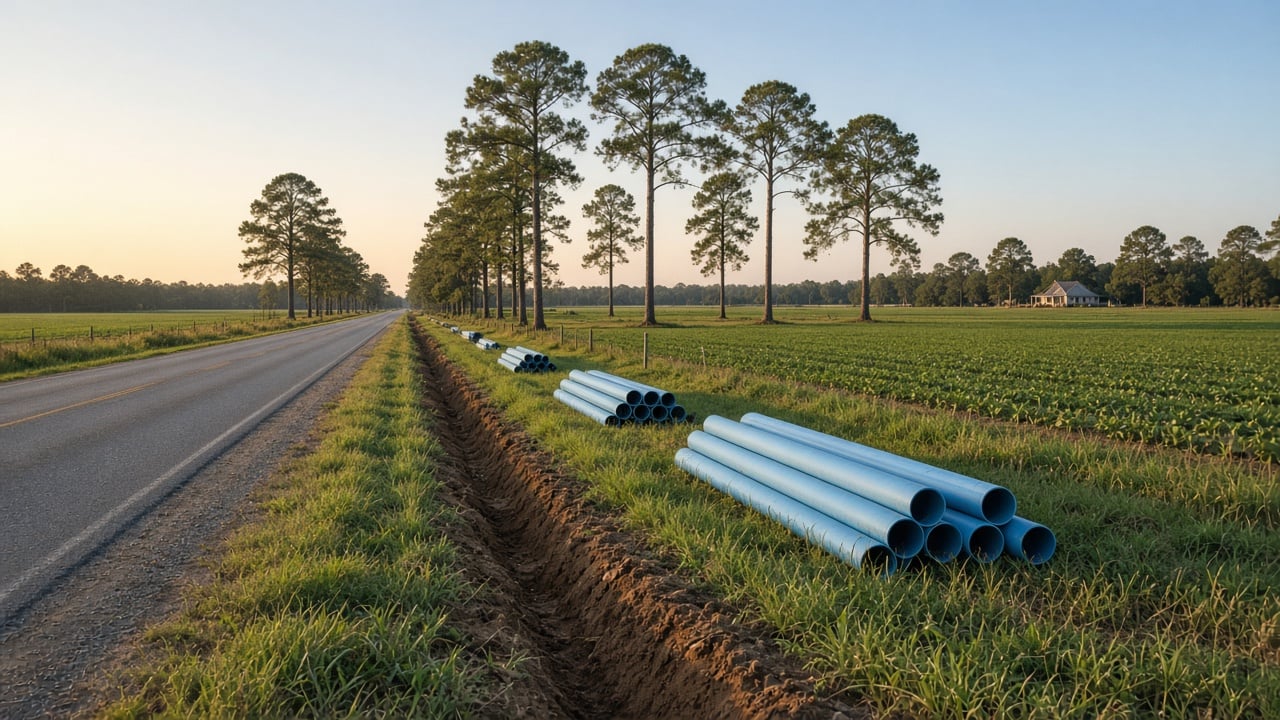
According to Port City Daily’s August 20, 2026 report, engineers from Highfill Infrastructure Engineering presented commissioners with options for bringing water to a portion of northwestern Pender County, where public water lines are lacking. One option would connect northwestern Pender, including parts of the U.S. 421 corridor from Penderlea, at an estimated $12.5 million, covering a pipeline extension, interconnection and distribution, and a new well. A second option, supplying the area from Malpass, was estimated at close to $20 million.
A state drinking water funding list from the N.C. Department of Environmental Quality also describes a Pender County “Penderlea-Hwy 421 Waterline” project: about 7.5 miles of 6- to 12-inch waterline to create loops and an interconnection with the Town of Harrells water system.
To pay for the work, county spokesperson Brandi Cobb told Port City Daily the county was looking at state revolving fund loans and a $3 million grant from the state’s drinking water and wastewater reserve.
A Bumpy Road to the Grant Application
The application hit a snag in September. The state deadline was Sept. 30, but only two commissioners attended the Sept. 21 meeting, leaving the board without a quorum to vote. Port City Daily covered the delay on Sept. 22, and WECT reported on Sept. 24 that the county would still move forward after talking with the funding agency.
At the Oct. 5 meeting, WWAY reported that commissioners unanimously directed the county’s utilities director to submit documentation for the West Pender Water Project grant, noting the state had granted an extension. Commissioner Jimmy Tate said he hoped first-phase funding would be awarded soon, but no timeline was given for an award or for construction.
Bottom line: this is a funding application, not a construction schedule. Treat any talk of “water coming soon” as a possibility, not a promise.
Why Water Matters So Much in Rural Pender
Pender County Utilities serves roughly 11,000 of the county’s approximately 72,000 residents, about 15%, according to Port City Daily. Its service is split among six water and sewer districts: Rocky Point/Topsail, Scotts Hill, Maple Hill, Central Pender, Moore’s Creek, and Columbia-Union. The county utilities page also notes that drinking water in the Maple Hill district has been purchased from the Onslow Water and Sewer Authority since 2022.
Everyone else relies on private wells. Well water can work perfectly well, but it puts testing, treatment, and maintenance on the owner. Commissioner Tate also said at the Oct. 5 meeting that he’s heard about water challenges on the east side of the county, so this isn’t only a western Pender conversation.
What It Means for Homeowners
Possible future connection
If funding comes through and lines are built, some properties along the route may eventually gain access to county water. Connection policies, tap fees, and whether hookup is required are details the county would set later, so ask Pender County Utilities directly if your property is near a proposed route.
Possible rate impacts for existing customers
County Manager Colby Sawyer told commissioners in August that grants carry no county match, but loans must be repaid and would likely result in countywide water rate increases for Pender Utility customers. If you’re already on county water in Hampstead, Rocky Point, or Burgaw, that’s worth watching as the funding mix becomes clear.
What It Means for Buyers and Sellers
Buyers: verify the water source
For any rural listing, confirm whether the home is on a private well or a public system. With a well, order a water quality test during your due diligence period, ask about the well’s age and depth, and look for any treatment equipment. Our earlier guide to buying land in Pender County covers wells, septic, and perc tests in more detail.
Sellers: document what you have
If you’re selling a well-served home, recent water test results and service records help buyers feel confident. Don’t market a property as getting county water unless the project is funded and the route is confirmed.
Frequently Asked Questions
Has the West Pender water project been funded?
Not as of the latest reporting we found. Commissioners authorized the grant documentation on Oct. 5, 2026, and no award date had been announced.
Which areas would it serve?
Reporting and state documents point to northwestern Pender, including Penderlea and parts of the U.S. 421 corridor, with a possible interconnection to Harrells. Final routes depend on funding and design.
Will my water bill go up?
It’s possible for existing Pender County Utilities customers if loans are part of the funding, according to the county manager’s August comments. No rate change has been announced.
Is a home on well water a bad buy?
Not at all. Many rural Pender homes run on wells. The key is testing the water and understanding maintenance before you close.
Looking at Rural Property in Pender County?
Western Pender offers space, privacy, and value you won’t find closer to the coast, but utilities take a little extra homework. We can help you sort out wells, septic, flood maps, and what’s planned nearby before you make a move.
Talk with Aspyre Collective about rural Pender County homes and land
Sources: Port City Daily (Aug. 20 and Sept. 22, 2026), WECT (Sept. 24, 2026), WWAY (Oct. 5, 2026), N.C. Department of Environmental Quality drinking water project list, and Pender County Utilities, all reviewed October 30, 2026.