



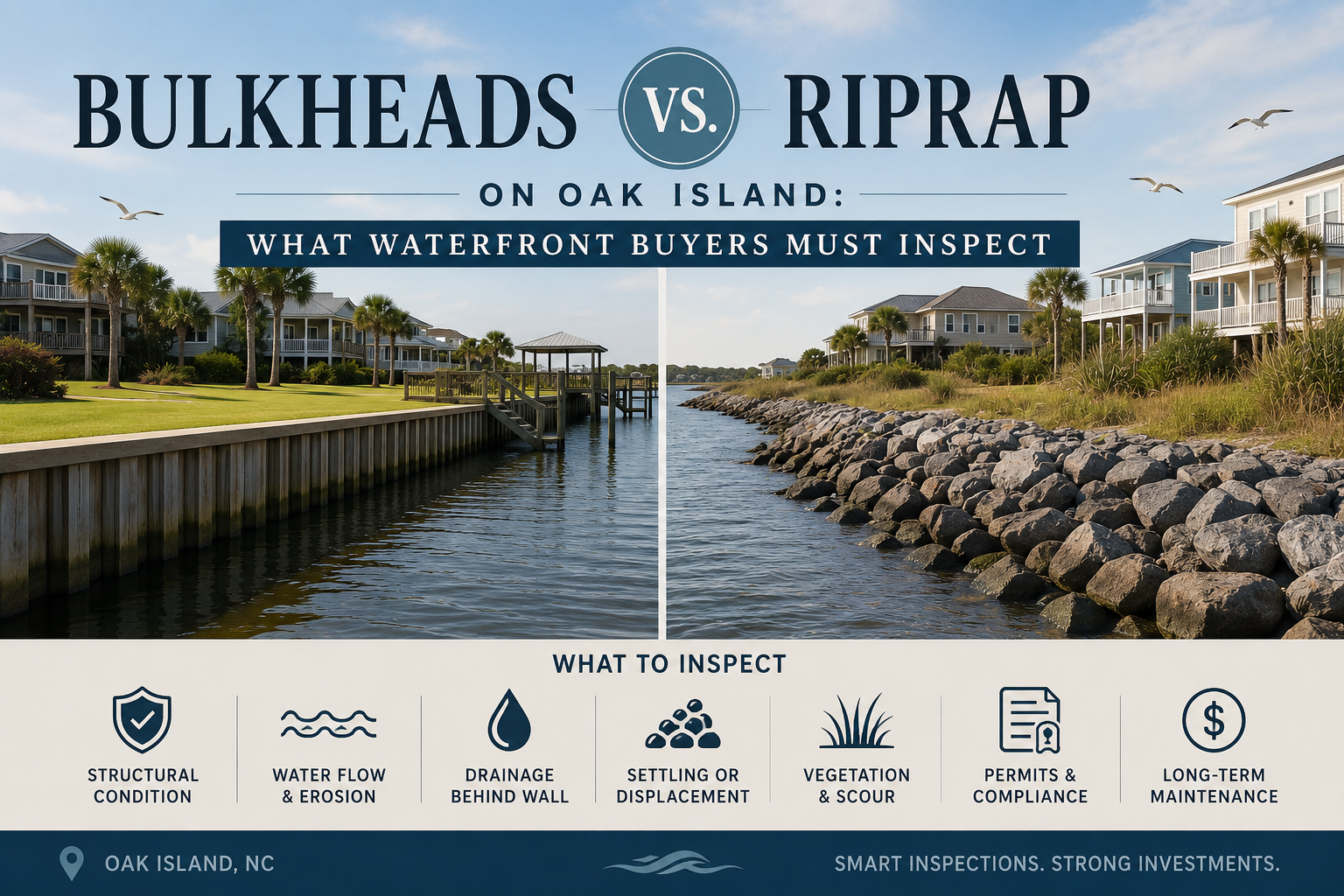
Key Takeaway / Local Summary:
Structural Protection: Bulkheads act as vertical retaining walls ideal for deepwater docks, whereas riprap consists of angled stone revetments that absorb wave energy naturally along coastal shorelines.
Permitting & Environmental Rules: Modifications or repairs to waterfront stabilization on Oak Island require approval under the North Carolina Coastal Area Management Act (CAMA) via local or state permit officers.
Inspection Essentials: Buyers must verify bulkhead tieback anchor integrity, weep hole drainage, and severe wood bore damage (marine organisms), or check riprap stone displacement and underlying geotextile filter fabric.
Buying a waterfront home on Oak Island—whether along the Intracoastal Waterway (ICW), Davis Canal, or Montgomery Slough—offers an unmatched coastal lifestyle. However, owning waterfront real estate in Brunswick County brings the responsibility of shoreline erosion control.
The two primary shoreline stabilization systems used on Oak Island are bulkheads and riprap revetments. Knowing how these structures differ, how they are regulated under North Carolina law, and what red flags to look for during your inspection window can save you tens of thousands of dollars in emergency repairs.
Bulkheads vs. Riprap: Side-by-Side Comparison
| Feature | Wooden/Vinyl Bulkhead | Riprap Sloped Stone |
| Design Type | Vertical retaining wall (treated timber, vinyl, or steel) | Sloped barrier of large granite/limestone boulders |
| Best Used For | Deepwater canal lots, boat slip landings, limited space | Tidal canals, marsh edges, high-wave energy shorelines |
| Wave Energy Handling | Deflects waves (can cause toe scour at base) | Absorbs wave energy across sloped stone surface |
| Typical Lifespan | 15–25 years (wood) / 30–50 years (vinyl) | 50+ years (requires minimal stone replenishment) |
| Maintenance Needs | High (tiebacks, caps, weep holes, marine borers) | Low (re-aligning displaced stones after major storms) |
| CAMA Permitting | Requires CAMA Minor/Major Permit for repair/replacement | Requires CAMA General/Minor Permit |
Critical Inspection Points for Waterfront Buyers
When purchasing an Oak Island property with existing shoreline stabilization, standard home inspectors often lack marine structural expertise. Hiring a qualified marine contractor during your North Carolina Due Diligence Period is essential.
Bulkhead System Cross-Section:
[Backfill Soil] ➔ [Tieback Rod] ➔ [Deadman Anchor] ➔ [Vertical Sheet Pile] ➔ [Waterline / Toe]
                                                           ▲
                                                (Check for Scour & Leaks)
1. Evaluating Wood and Vinyl Bulkheads
Tieback Anchors & Deadmen: Bulkheads rely on metal tieback rods connected to buried concrete or wooden anchors ("deadmen") in the yard. Look for bowing or leaning walls, which indicate snapping or corroded tiebacks beneath the lawn.
Drainage & Weep Holes: Water trapped behind a bulkhead creates immense hydrostatic pressure. Ensure weep holes are clear and backed with filter fabric so soil doesn't wash out into the canal.
Toe Scour & Marine Borers: On low tide, inspect the base ("toe") of the bulkhead. Look for soil erosion where water meets the wall base, and check wooden posts for shipworms or gribbles (marine borers that hollow out timber).
2. Evaluating Riprap Stone Revetments
Geotextile Filter Fabric: Riprap must be installed over a heavy-duty geotextile filter fabric. If the fabric is torn or missing, tidal action will pull underlying soil through the stones, creating hidden sinkholes in your back lawn.
Stone Displacement & Sizing: Check whether recent tropical storms or hurricane swells have shifted stones down the slope. Ensure the stone size matches the water energy level along that specific stretch of Davis Canal or the ICW.
Navigating NC CAMA Permits on Oak Island
In North Carolina, all shoreline property stabilization is governed by the Coastal Area Management Act (CAMA) through the Department of Environmental Quality (DEQ).
CAMA Minor Permits: Generally required for routine maintenance, replacing existing bulkheads in-place, or installing small riprap revetments along canals. These are issued locally by Brunswick County or Oak Island designated permit officers.
CAMA Major Permits: Required if you plan to extend a wall further open water, alter marshland, or build large complex marina structures.
Before closing on an Oak Island waterfront property, always require the seller to provide copies of original CAMA permits and surveys confirming the structure sits within legal property boundaries.
Looking for waterfront homes or boat dock properties on Oak Island? Contact Aspyre Realty Group at 910-241-0404 or [email protected] to connect with our coastal property specialists.
Check out this article next