


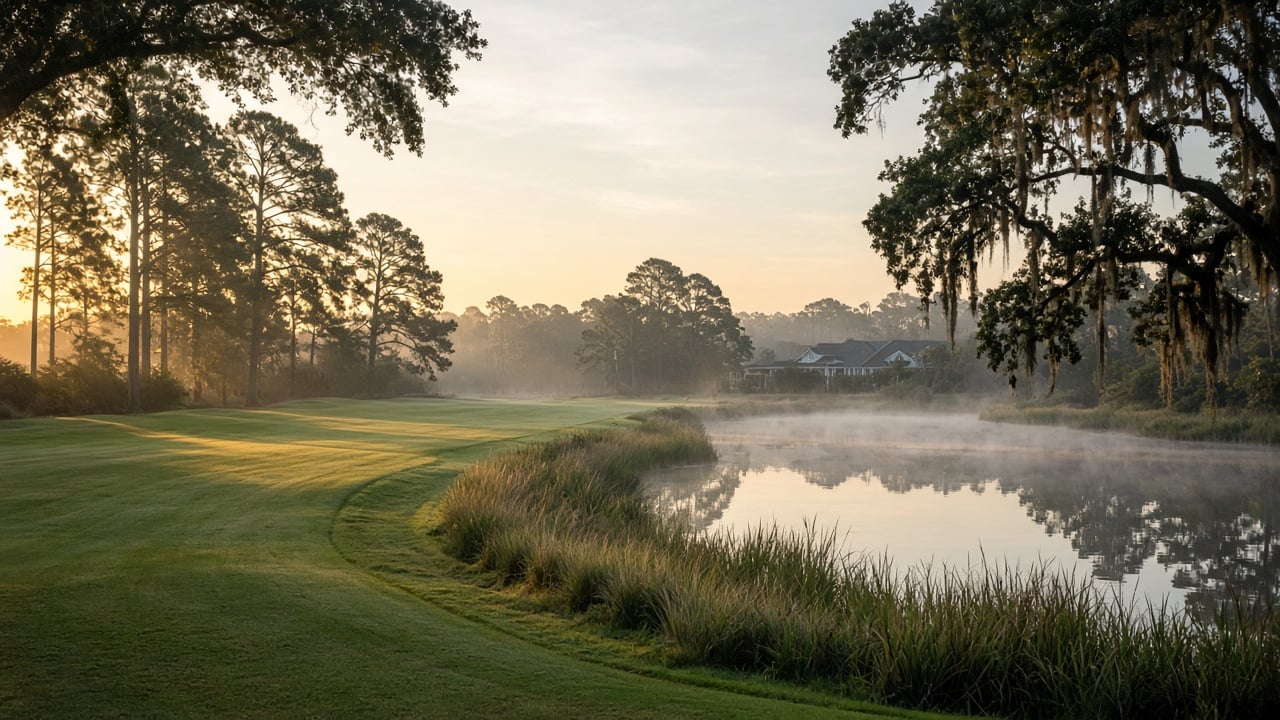
Golf has shaped Brunswick County for decades. Drive U.S. 17 from Leland to Calabash and you pass one golf community after another, from St. James near Southport to Ocean Ridge Plantation near Ocean Isle Beach and the clusters of courses around Sunset Beach and Carolina Shores. For a lot of buyers, a home on or near a fairway is the whole point of moving here. For others, it’s a nice extra that comes bundled with the neighborhood.
Either way, buying in a golf community is a little different from buying a typical subdivision home. Recent news is a good reminder why. In October, the Town of Carolina Shores approved a 109-home neighborhood on the former Carolina Shores Golf & Country Club, which closed in November 2024. According to On the Green Magazine (Oct. 13, 2026), it’s the latest of nine-plus courses to close in Brunswick County over the past 26 years, including Brierwood in 2017 and Farmstead in 2021. (We covered the Carolina Shores redevelopment in detail here.)
That doesn’t mean golf homes are a bad bet. It means the smart move is to buy the course and the community, not just the view. Here’s what we walk our buyers through.
Course-Front, Course-View, or Just in the Community?
Start by being clear about what you’re actually paying for:
- Course-front lots back directly onto a fairway, tee, or green. They usually carry the biggest premium and the most open views, plus the most exposure to stray golf balls, early-morning mowers, and cart traffic.
- Course-view or pond-view lots may look across water or a fairway from a distance. You get much of the scenery with less of the noise.
- Interior lots in a golf community often cost less and still give you access to the clubhouse, pools, and social life, if membership is open to you.
Walk the lot at different times of day. Stand in the backyard during a busy morning tee time. That one visit will tell you more than any listing photo.
Who Owns the Course?
This is the question that matters most, and the answer varies a lot from one Brunswick County community to the next. Some courses are owned by the residents or the club members. Others are owned by a private operator or the original developer, separate from the homeowners association. That difference affects how stable the course is and how much say homeowners have if things change.
Questions to ask before you write an offer:
- Is the course owned by the HOA, a member-owned club, or a private company?
- Is it a private club, semi-private, or open to the public?
- How has the course been doing lately? Ask about recent improvements, closures for renovation, and membership trends.
- What is the course property zoned, and what could be built there if it ever stopped operating as golf?
That last question is exactly what Carolina Shores neighbors faced. The former course there was zoned as a Conservation Recreation District, which allowed one-acre homesites without a rezoning. Zoning information is public, and the county or town planning office can tell you what applies to a specific parcel.
HOA Dues, Club Dues, and What Each Covers
In many golf communities there are two separate costs: the HOA (sometimes a property owners association) and the club. They’re easy to confuse. Ask for both in writing:
- HOA or POA dues typically cover common areas, roads, gates, and amenities that belong to the community.
- Club membership may be optional, mandatory, or tiered (social, sports, full golf). Some clubs charge initiation fees or transfer fees when a home sells.
- Special assessments can come up for road repairs, pond and drainage work, or clubhouse projects. Ask whether any are planned or under discussion.
In North Carolina, sellers of most resale homes must give buyers the Residential Property and Owners’ Association Disclosure Statement no later than the time the buyer makes an offer, under G.S. Chapter 47E. That form includes questions about the owners’ association, dues, and fees. Keep in mind that sellers can answer some questions with “No Representation,” so the form is a starting point, not the whole story. Your due diligence period is the time to request the HOA’s budget, recent minutes, reserve information, and the declaration and bylaws.
Practical Things Buyers Overlook
Golf balls and liability
Windows, siding, screened porches, and cars can take hits on course-front lots, especially near tee landing areas. Ask the seller how often it happens, and look for patched siding or replaced screens.
Ponds, drainage, and flood zones
Brunswick County golf courses are full of ponds that double as stormwater systems. That’s part of the charm, but it also means you should check the lot’s flood zone, look at how the yard drains after a heavy rain, and ask who maintains the pond banks. Your insurance agent can quote flood and homeowners coverage before your due diligence period ends.
Turf care and quiet hours
Course maintenance starts early. Mowers, aerators, and irrigation can run at dawn. Some buyers love it; others don’t.
Thinking About Resale
Golf communities tend to attract retirees, second-home buyers, and relocators, which is a big part of Brunswick County’s buyer pool. A well-run course and an active clubhouse can help a home stand out when you sell. A struggling course, rising club costs, or uncertainty about the land’s future can do the opposite. The more you know going in, the easier it is to explain the community to the next buyer.
FAQ
Do I have to join the club if I buy in a golf community?
It depends on the community. Some have mandatory memberships tied to the property and others are completely optional. Read the community documents and ask the club directly before you make an offer.
What happens to my home if the golf course closes?
That depends on who owns the course and how it’s zoned. In Carolina Shores, the former course was approved for one-acre homesites. Elsewhere it could look very different, which is why checking zoning and ownership up front matters.
Is a course-front lot worth the premium?
For buyers who value open views and golf access, it often is. For others, a course-view or interior lot offers a similar lifestyle for less. Comparing recent sales inside the same community is the best way to judge it.
Find the Right Golf Community With a Local Team
From Leland and Southport to Ocean Isle Beach, Sunset Beach, and Calabash, every Brunswick County golf community has its own ownership setup, fee structure, and feel. We can help you compare them, pull the documents that matter, and spot the questions to ask before you’re under contract. Contact Aspyre Collective to start your search.